

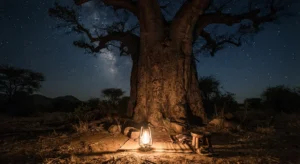
Long ago, before electricity reached the villages, night arrived gently in Kitemu. It came with the smell of wood smoke, the lowing of cattle, and the soft clink of bowls as families settled down to supper. The round huts stood close together under their thick grass roofs, and when the drums went quiet, the crickets took up the song.
In a small hut at the edge of the village lived Nia, a girl of nine with quick feet and a habit of asking questions. Her grandmother was old and wise, with silver in her hair and stories in her hands. Every evening, Nia filled her grandmother’s little clay lantern with oil, trimmed the wick, and set it by the doorway. “For anyone still on the road,” her grandmother always said. Nia never quite understood. Who would be out there after dark, when the path was dark and the bush was full of shadows?
Her days were full of small chores. She swept the courtyard, carried water from the well, and helped the women pound grain. But whenever she passed the great baobab at the edge of the village, she slowed to look at it. Its trunk was so wide that six children could not circle it, and its branches held the sky like an old umbrella. People said the tree had stood there since the first arrivals, and that it watched over everyone who passed beneath it.
Then came a dry season that tried everyone’s patience. Week after week, the sun rose hot and white. The path to the market grew pale with dust, the wells sank low, and the leaves on the neem trees curled inward. Even the lantern oil had to be rationed. “We must save what we have,” Grandmother said, but each evening she still made Nia set the little lamp outside.
One afternoon, while carrying water home, Nia saw an old man sitting beneath the great baobab. His travelling stick lay beside him, his clothes were grey with dust, and his lips were cracked. He had clearly walked a long way. Nia hesitated only a moment. Then she knelt, tipped her calabash, and offered him a drink.
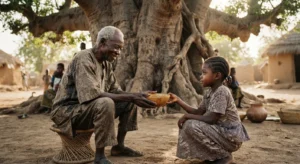
The old man drank slowly, as though the water were precious. When he finished, he looked at her with kind, tired eyes. “A kindness given when you have little is worth more than a feast given when you have plenty,” he said. Nia did not know what to answer, so she only smiled.
When she got home, she told Grandmother about the stranger. The old woman listened, then nodded. “A hand that gives will never go empty,” she said. “One day you will understand.”
That night, the lantern burned as it always did, a small gold star beside the doorway. When Nia woke at dawn, the lamp had gone out, but beside it lay a small brown seed, smooth as a button. She turned it over in her palm. It was unlike any seed she knew.
She planted it near the baobab, covering it with a finger of soil, and watered it from her own cup. Each morning she returned to check on it. For many days, nothing happened. “Perhaps it is only a stone,” she thought. But she kept watering it, and she kept lighting the lantern.
Weeks passed. The winds changed, the clouds gathered, and the rains came back in a great green rush. The little seed split open. A tender shoot lifted its head, then two leaves unfolded, small and shining. Nia clapped so loudly that the birds flew from the baobab.
Years went by. The shoot became a slender tree, then a wide one. Its branches grew thick enough to shelter travellers, and its shade was cool even at noon. People began to say, “Let us rest under Nia’s Tree,” and the name stayed.
Nia grew into a woman, but she never stopped filling a lantern at dusk. And whenever someone asked why, she would say, “Because someone once shared water with me, and kindness is a light that never runs out.”
Get real time update about this post category directly on your device, subscribe now.